This is a no charge online meeting service that allows you to gather people and allows them to see your computer screen as you demonstrate, teach or collaborate. The applications for your business are endless: https://join.me/
The thing I remember most about getting email functionality at work (in 1990, I think) was that I could get rid of those 3-part memos. Some of you will remember them – usually they had ‘Memorandum’ across the top, and places to write your recipient’s name/department, your message, and their reply. They were 3 sheets with carbon paper in between - so you could keep a copy for follow-up and the recipient could write a note to return to you, keeping a copy for themselves. They even folded a certain way for interoffice mail. Yes, they were handwritten! I used the phone a lot more back then. When I wrote those 3-part memos, it was generally for two reasons: to communicate detailed info, and/or to have a record of decisions. When I think of the number of emails I get daily now, and visualize them as a stack of 3-part memos... well, it would be a big stack! Now we use email for a long list of other reasons, far beyond those two listed above. It has opened doors and provided oppo...
(guest post by Mike Tanner) To suggest that I’m a big fan of podcasts would be… a bit of an understatement. In addition to being the host of 3.5 podcasts (it’s a long story), I provide podcasting consulting, speak on podcasting panels and once had a dream that I was the host of a potato chip podcast called “Chip Off The Old Block” (That podcast should be coming out in the fall.) I started podcasting because I enjoyed it. But what I’ve discovered about podcasting as it relates to business has left me realizing that I made the absolute right decision when I decided to start broadcasting my thoughts on an audio medium. So here are three reasons why businesses should be podcasting. Passive Advertising I am a big fan of social media advertising. The targeting options available on major platforms are outstanding and things like analytics and retargeting make it a no-brainer to use social to promote your business, whether that’s through the use of paid ads or just a solid soc...
It's been 3 years since CASL came into effect in Canada and the grace period ends on July 1, 2017 . I know, it's an icky subject but I want to keep you informed. There's a lot to know but I'll keep this really brief. Here are the two most important things you need to know about CASL right now. First, if you own a business and use email for business, every email sent is governed by CASL. It has nothing to do with the application you use, or how many people you send to at a time. Many business people seem to think CASL doesn't apply to them. It definitely does! Second, the good news. Even though CASL applies to your email communication, unless you have many thousands of subscribers, you're unlikely to ever garner enough attention to warrant an investigation by the CRTC. There is possibly some new legislation coming that will allow civil cases although I have a hard time imagining the grounds for any such cases. For some businesses, such as mine, it'...
If you're beating around the bush, you're wasting time and possibly money. Neil Everton of Podium Media and Communications Coaching suggests we look at our writing with a critical eye and ask: "Am I prepared to pay $1 for every word I've written?" Unproductive words and phrases abound. I've written before about wimpy phrases to avoid ; here are some slightly pretentious ones to also slice out. “Due to the fact that...” Use “because” at the beginning, or rearrange the sentence to use it in the middle. “For the most part...” Eliminate this one completely without changing your meaning. “In my opinion...” Use “I think” or eliminate it all together. I'm already expecting your opinion if I'm reading your writing. “On a regular basis...” Save $3 here by using “regularly” or “always” at the end of the sentence instead. “The first step is to...” Chop out 4 words and simply use “first”. Using more words doesn't mean you'll get read...
In the normal course of my day, I am constantly looking businesses up online. If I am going to talk to you, meet with you, consider buying your product or using your services, I've looked you up online. Increasingly, I am finding content that I am certain you do not want representing you. Maybe you think you do not need an online presence. Maybe you have an old website that you think is working to the extent you need it to. And maybe you are wrong. Think of all the reasons you Google a business: looking for a product or service looking for a location looking for directions or a map looking for a policy preparing for a meeting If you are using an online search to find what you are looking for, it stands to reason that others are as well. Many, many others. What do you want them to find when they look? We've said it before and it is worth repeating. Google your business at least quarterly. Set your website as your browser's default home page so you are seei...
"Sign up for our newsletter to keep up to date with us." "Sign up to get company news and other info." Does that make you want to invite yet another email into your inbox? I think not. what NOT to do I did a search on Twitter for #enewsletter . One thing stood out: companies luring people to sign up with the promise of company news. Now, there aren't many instances where I'd be interested in hearing about new employees and new client projects and new branch offices. Here are those instances: you are my friend, you are my client, or you are my supplier. And if you are any of those, it won't be long before I'm telling you what you're doing wrong. If I don't know you, your company news won't interest me or anyone else who doesn't know you. You need to lure me with something useful or interesting first. (And it seems especially lame when those posts are lined up all in a row in Hootsuite.) I'm not saying not t...
If your ideal customer is new to social media, your autoresponder messages might be creeping them out. At one time I had this vision of some big guy hunched over his keyboard poised to pounce on my 'Follow'. If your ideal customer is more tech savvy, they'll recognize an autoresponder immediately. (Really? You expect me to interact with a program?) I liken autoresponders on social media to email spammers . Both are giving their medium a bum rap. A recent Twitter following spree on my part resulted in 16 automated tweets (close to 10% of those I followed). At least I think they were autoresponders. There's the rub. Even if you take time to respond to people individually, now they may assume it's an autoresponder. The legitimacy of your action is lost in the sea of spammers. photo by wnstn / Flickr Click to Tweet this Article
You've just had a great experience working with another small business owner. You know how important testimonials are , but writing them is not a comfortable experience for you. So, you procrastinate. Here are some tips to get that off your TO DO list. #1. Jot down 3-4 descriptive words or phrases that immediately come to mind about the business, the product or service, the consultant, the buying process, and such. When you start writing and are stuck for a word, refer to this list. (Examples: reliable, honest, practical, creative, solid) #2. Get clear on the benefit. Before you start to write, consider your responses to these questions: What was your problem? What was the solution and how was it unique? What particularly stood out about the buying experience? #3. Start with feelings. You are really writing the testimonial for potential customers of the business. Think about how you felt and tell them how they will feel. Use comparisons, such as "It made me fee...
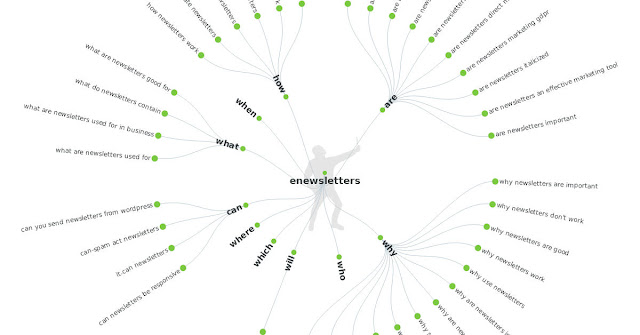
Stuck, uninspired, unmotivated, feeling stale - anyone who blogs regularly is going to experience those things from time to time. Especially when we're busy, it's hard to take time to get inspired. Sometimes I don't need inspiration so much as a new angle - a different perspective or approach to information, advice and ideas I've already covered. And that's where answerthepublic.com comes in. Its insights are based on the data of web searches and it shows you results graphically. In no time you'll pin down an approach, and be writing and done. The image above (cropped) is from my search of the term "enewsletters". The next time you just need the spark of an idea to get going, try answerthepublic.com . Click to Tweet this Article
Your website is about what you do and your blog is about why you love what you do. I wish I could say I made that up but I read it somewhere. It has really stuck with me though. What an easy rule to follow! For newsletters and email communication, your content will depend on your strategy and goals. Choose to send either a mostly promotional email or a mostly informational email. I recommend 80% information and 20% promotion – or vice versa. Having this focus makes it clear to your subscribers what to expect. You are better to send two separate emails than to send one email that is 50/50. Each type of email has its place. I can get just as excited about a shoe sale as I do about a new idea. What do your subscribers want to read about (or look at)? That is more important than what you want to write about. (It’s also the difference between blogs and newsletters.) Content creation is one of the big challenges for my newsletter clients. I always tell them that it gets easier...





Comments
Post a Comment